


[ad_1]
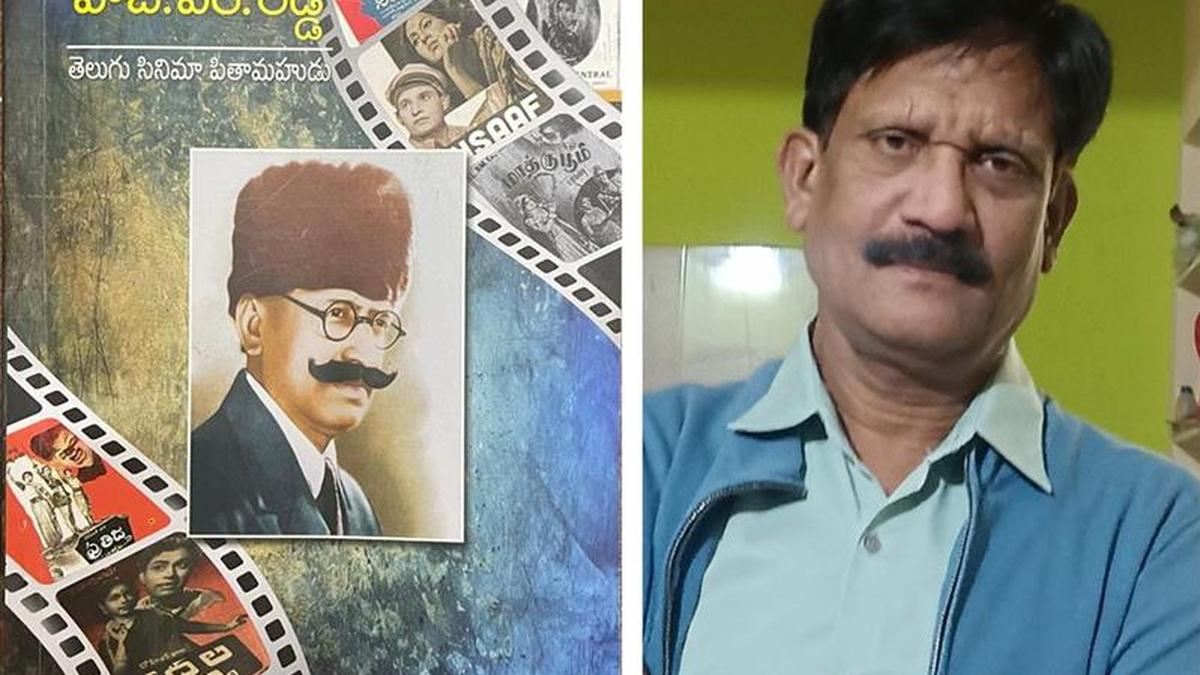
Book cover; H Ramesh Babu
| Photo Credit: Special Arrangement
For nearly three decades, author H. Ramesh Babu has been immersed in film research. Yet, he says, one persistent question troubled him: how could the man universally hailed as the ‘godfather of the Telugu talkie’ be reduced to a handful of lines in film history?
That question led to a decade-long research project and culminated in his exhaustive Telugu book H. M. Reddy – Telugu Cinema Pitamahudu, which was released recently.
“Wherever I looked, everyone repeated the same thing,” says Ramesh Babu. “Two pages, sometimes even less. No detailed filmography or analysis. Just the same borrowed paragraphs.” Determined not to “write what everyone already knows”, he began collecting material — hundreds of newspaper clippings in Telugu and English, archival references, rare interviews and production notes. What emerged was not just a biography, but a reclamation.

Ramesh Babu argues that Reddy’s contribution was systematically overlooked, both during his lifetime and after. “He was neglected even when he was alive,” he says, attributing this partly to Reddy’s uncompromising working style.
The book reconstructs the first two decades of the talkie era — from acting styles shaped by theatre traditions to early experiments with sound recording, music integration and studio production methods.
Silent to sound
Hanumantha Muniappa Reddy began his career in the silent era of Indian cinema, working in erstwhile Bombay when the industry was still in its formative years. Long before he became celebrated for directing the first Telugu talkie Bhakta Prahlada (1932) and the pioneering bilingual talkie Kalidas (1931) — in which characters spoke Tamil, Telugu and Hindi — he was absorbing the craft in silent film studios.
He assisted Ardeshir Irani in India’s first talkie, Alam Ara. He was associated with the filmmaking circles of pioneers such as Baburao Painter and gained practical experience in production and direction. Like many technicians of that period, his contributions went largely undocumented, as records from the 1920s are sparse and many films have been lost. His grounding in silent cinema, however, equipped him with the technical understanding that later enabled him to play a crucial role in ushering South Indian cinema into the sound era.

According to the author, Reddy pioneered a delicate balance between artistic storytelling and commercial elements. He points to films such as Gruha Lakshmi and the Tamil hit Matrubhoomi as examples of Reddy’s instinct for audience engagement.
While some contemporaries reportedly disapproved of what they saw as overt commercial elements, Ramesh Babu argues that Reddy understood that cinema had to sustain itself economically to evolve artistically in the 1930s and ‘40s.

One of the striking aspects of the book is its questioning of long-accepted facts. Ramesh Babu revisits conflicting claims about Reddy’s year of birth — variously cited as 1890 or 1893 — and investigates discrepancies about his hometown. Rather than choosing a convenient version, he presents multiple sources before arriving at carefully reasoned conclusions. Yesteryear hero and a contemporary of NTR and ANR, Kantharao’s interview in one of the regional publications was one of the sources to determine Reddy’s birth year for Ramesh Babu. He also documents Reddy’s final days and death with archival evidence, ensuring that the closing chapter of the filmmaker’s life is recorded with dignity.
With no surviving family members and most associates gone, reconstructing Reddy’s life required piecing together fragments. “I have filled the gap,” Ramesh Babu says with satisfaction. “From the beginning to the last day.”
The book, now being prepared for an English edition, aims to become the definitive reference on H. M. Reddy.
(H. M Reddy – Telugu Cinema Pitamahudu; By H Ramesh Babu; Chinni Publications; ₹175)
Published – March 05, 2026 10:23 am IST
[ad_2]
Source link

 Total Users : 10225438
 Views Today : 2498