


[ad_1]
It’s been thoroughly entertaining witnessing Indian cinephiles wage a full-scale war against PVR just to get Project Hail Mary onto a screen it was so obviously built for, while a certain unmentionable other continues to gluttonise that real estate. I missed the IMAX version (pain, honestly), which does feel like leaving some of the experience on the table, but even in a regular theatre, Phil Lord and Christopher Miller have made another bright, buoyant, summer blockbuster that relishes in its nerdy delight and reminds us why going to the movies will always slap (IMAX or otherwise).

Adapted from Andy Weir’s 2021 novel, with Drew Goddard once again stepping in after The Martian to translate dense scientific prose into something legible and propulsive, Project Hail Mary opens with Ryan Gosling’s Dr. Ryland Grace waking up aboard an interstellar spacecraft, disoriented, half-lucid, and very much alone, his memory wiped clean by prolonged hypersleep as the story begins to fold in on itself through a steady drip of flashbacks that reconstruct his identity and the stakes of this Hail Mary effort.
The premise borrows liberally from the procedural pleasures that powered The Martian, with similar emphasis on problem-solving under pressure and incremental discoveries, though where Matt Damon radiated a sense of competence under a sharp-eyed Ridley Scott from the outset, Gosling manoeuvres through the fumbling, bumbling and socially awkward Grace with the power of charisma alone. Lord & Miller allow Gosling’s offbeat timing and disarming clumsiness to anchor beats that might otherwise feel overly familiar.
Project Hail Mary (English, Eridean)
Director: Phil Lord and Christopher Miller
Cast: Ryan Gosling, Sandra Hüller, James Ortiz, Lionel Boyce
Runtime: 156 minutes
Storyline: A science teacher wakes up on a spaceship with no recollection of who he is or how he got there, and soon discovers he must solve the riddle behind a mysterious substance that’s causing the sun to die out
The science here retains Weir’s signature density. The microscopic threat to humanity is dubbed the astrophage or “star-eater”, that pushes Earth towards an inevitable extinction-level event while also offering the improbable solution in the form of a volatile fuel source, and the film does a commendable job of staging these abstract scientific ideas through tactile experimentation, even as it occasionally oversimplifies or dumbs down its logic for comic relief. There are echoes of Interstellar in the apocalyptic framing and the emphasis on collective survival through the Lazarus missions, and shades of Arrival in the linguistic and philosophical dimensions of first contact. However, Project Hail Mary resists the heavy solemnity of Nolan and Villeneuve by grounding its inquiry in a more accessible, almost casual humanism, that distills cosmic dread through the perspective of a loser science teacher, who responds to the end of the world with a shrug, a shriek, and the determination to keep going.
A still from ‘Project Hail Mary’
| Photo Credit:
Amazon MGM Studios
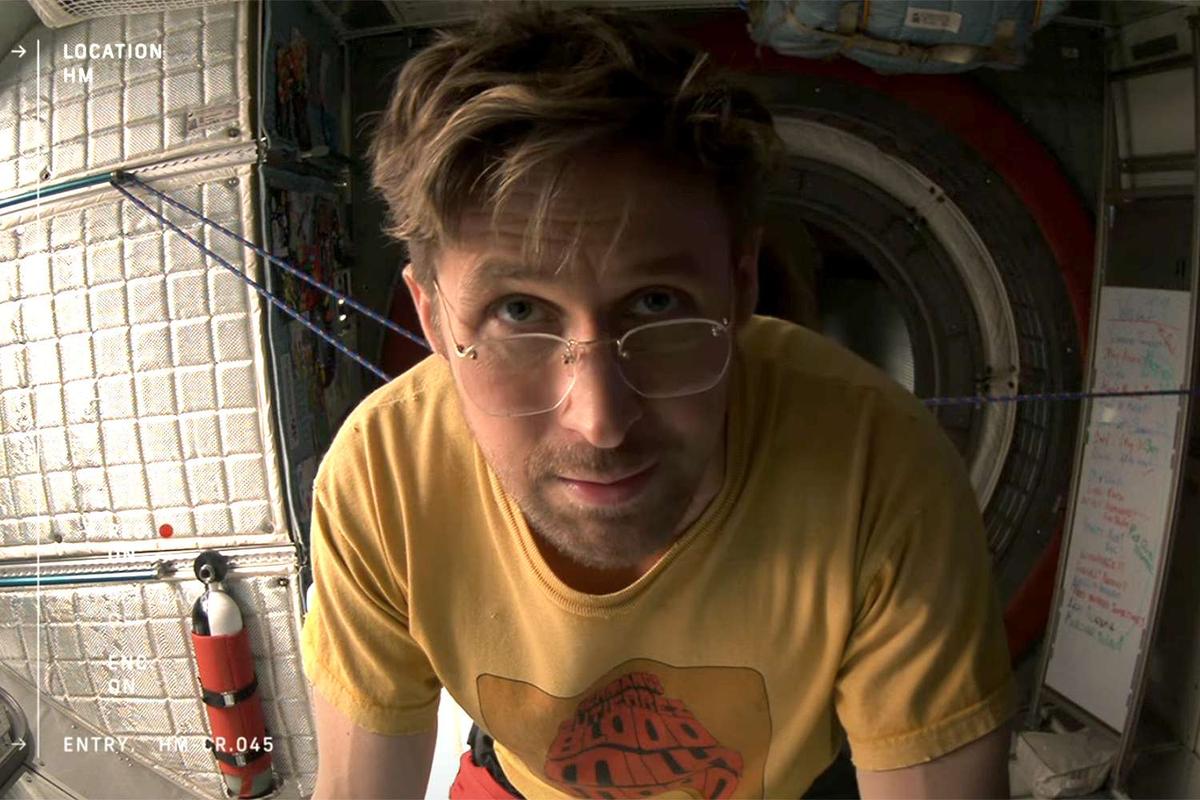
Gosling understands this calibration instinctively, shaping Grace as a man devoid of any semblance of heroic resolve, defined instead by a series of small, often reluctant choices that accumulate into something resembling courage. He plays the character’s clumsiness, social discomfort, and underlying decency with a remarkable earnestness, sporting his perfect tousled locks and snug cardigans over silly graphic tees. There is a perpetual agitation to his physicality, particularly in the early stretches where he struggles with basic motor function, that gradually gives way to a more assured presence. In the process, Gosling seems to have simultaneously evolved into the best iteration of the internet’s long-running “He’s Literally Me” fixation, as Grace embodies a version of that archetype that feels healthier, more outward-looking and far more generous than its edgier predecessors.

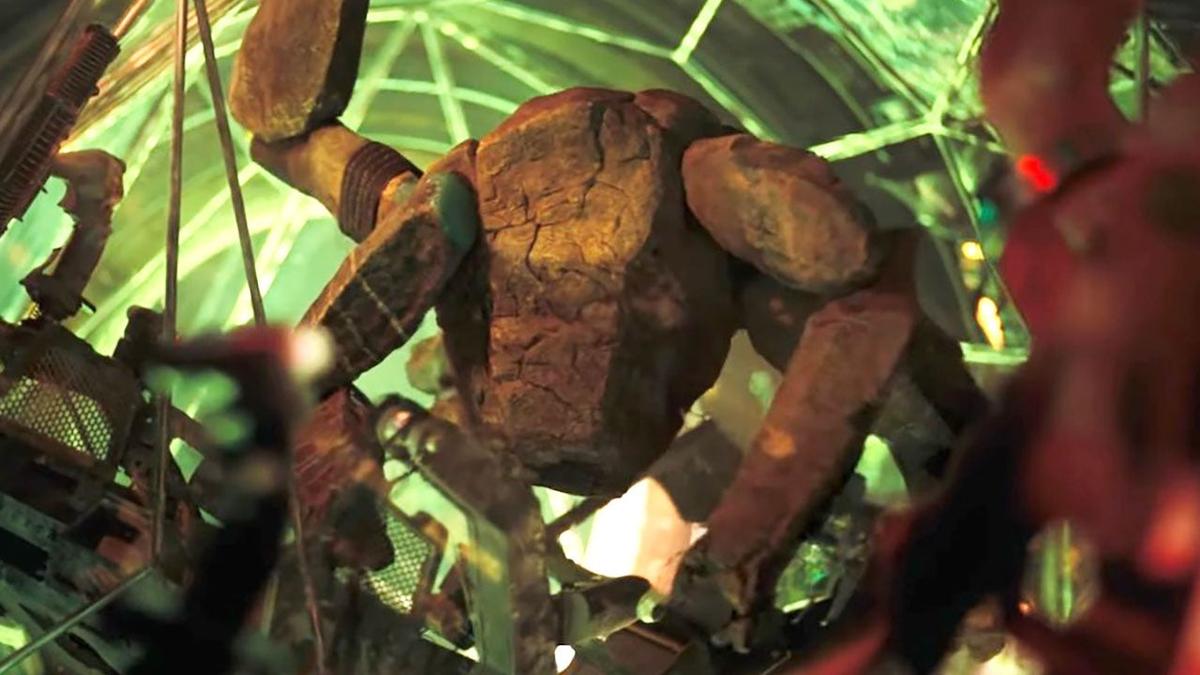
Grace soon reaches his destination solar system having slowly remembered that he wasn’t chosen for this mission so much as cornered into it— a last-minute replacement on a one-way trip to figure out why this lone star system has somehow dodged the astrophage apocalypse that’s busy dimming the Sun and freezing Earth. The loneliness of that setup is immediately punctured when he spots another spacecraft already in orbit, and what is a surprisingly courteous bit of orbital flirting, the two ships circling, stalling, easing into each other’s paths like they’re trying not to come on too strong before finally committing to a handshake. And that handshake is a 3D-printed tunnel bridging the gap, capped off by a transparent xenonite wall that lets them stare each other down. It’s through that pane that Grace first meets Rocky, a five-limbed, rock-built creature of interlocking mineral plates, forged in a high-pressure ammonia world and navigating entirely through a chiarscuro echolocation.
A still from ‘Project Hail Mary’
| Photo Credit:
Amazon MGM Studios
The first contact is nervy before it finds rhythm, with both of them mirroring movements awkwardly and avoiding any serious eye contact, even paying ode to John William’s D–E–C–C–G motif from Close Encounters. From there, the film doubles down on the mechanics of understanding, and this is where it gets properly fun: Rocky starts 3D-printing little physical models to explain concepts, essentially turning language into Lego, while Grace builds a translation system by mapping sound to meaning— both approaches clunky at first and then gradually syncing through a lot of trial and error. It’s one of the film’s smartest stretches because it renders the act of communication as actual, physical work instead of sheer movie magic.
The film quickly shifts into a collaborative mode that ties directly into the central mission, with new bunk-buddies Grace and Rocky working together to investigate why Tau Ceti has resisted the astrophage infection that is consuming stars across multiple systems. Their partnership develops within this framework of shared labour and improvised fixes. But what makes their bromance so effective is the way both characters approach problems with a similar literal-minded troubleshooting, stripping communication down to instruction, response and verification, which produces a kind of tender neurodivergent intimacy.

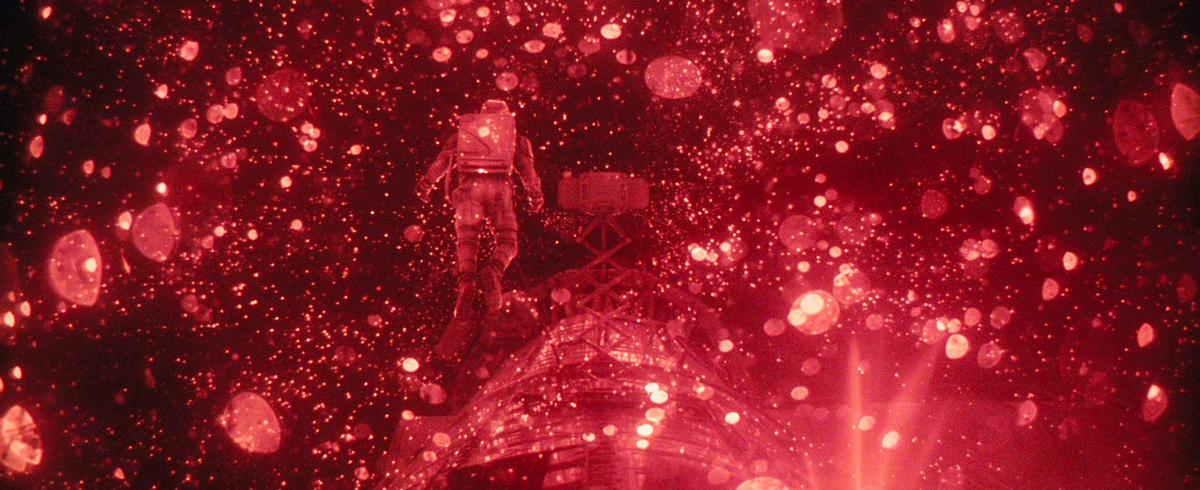
Formally, this is Greig Fraser doing what he does best, which is making scale feel tactile instead of abstracted, and making the most of the IMAX format not just for size but for weight, so the void of space feels genuinely vast while the human body inside it always looks slightly outmatched, even if he occasionally leans a bit too hard on those tilted, queasy frames that threaten motion sickness. Big visual ideas land cleanly, from the eerie sweep of the Petrova Line to the strange, almost organic behaviour of astrophage and the shimmering, hostile beauty of Tau Ceti and its planets; all of it grounded in a design philosophy that benefits from a commitment to practical effects. Meanwhile, Daniel Pemberton’s ethereal score knows when to swell and when to step back, bouncing between operatic wonder and a goofiness without overwhelming the tonal duality.
A still from ‘Project Hail Mary’
| Photo Credit:
Amazon MGM Studios
The runtime does start to show its hand in the final stretch, which keeps circling the landing strip, and the script never quite pushes beyond the comforts of a well-made studio blockbuster, though there’s an honesty to that choice which works in its favour because the film is clearly more interested in the process of figuring things out than dressing itself up as something profound.

Project Hail Mary is a rare piece of large-scale science fiction that chooses optimism without irony. In a moment where most end-of-the-world stories feel like they’re reflecting the worst instincts of the present, this one sneaks in softer, more persistent ideas, that may be enough to tilt things the other way. Perhaps the image of Ryan Gosling in his slightly scuffed-up, slutty little glasses, flashing that dogged, dumbass smile while walking along an alien shoreline with his autistic alien bestie, many light years away from home, feels like a perfectly decent reason to keep going. I too would abandon humanity to spend my days teaching a bunch of sentient rocks, because if it wasn’t obvious already… he is indeed literally me.
Project Hail Mary is currently running in theatres, including a fresh batch of IMAX shows (good job guys)
Published – March 27, 2026 10:15 am IST
[ad_2]
Source link

 Total Users : 10166494
 Views Today : 3574