


[ad_1]
The past week has witnessed strife between exhibitors and producers of Telugu cinema. Citing falling footfalls, the Telangana Exhibitors Association has urged producers to agree to a percentage revenue-sharing system as opposed to the prevailing fixed rental system at the earliest. This, they state, will help single screen theatres cope with operational costs even when films do not succeed at the box office.
Several producers, however, say the demand for a swift change can dent their earnings from the films awaiting release, beginning with director Buchi Babu Sana’s Peddi starring Ram Charan, scheduled to release on June 4.
Earlier this week, as exhibitors and producers resorted to media interactions rather than internal talks, the rift widened. This is a rapidly evolving situation and as on May 14 evening, representatives of The Telangana Exhibitors Association stated that single screens across Telangana may not screen Peddi if industry bodies do not agree on a percentage model.
However, on May 15 morning, more than 50 producers were in a huddle, after which producer Dil Raju stated that a committee is being formed with representatives of different industry bodies to arrive at a mutually beneficial system. He also stated that Peddi will release unhindered.

What is the prevailing rental model?
Single screen theatres pay distributors/producers a fixed amount as rent to screen a film. This amount is pre-determined according to the seating capacity and location of the single screen theatre. Exhibitors pay this rent regardless of how the film performs at the box office. Exhibitors say this model is not sustainable, since their earnings largely rely on the box office performance of a film to recover the rent and operational costs. They added that more than 100 single screens across Telangana have closed in the last three years due to diminishing revenues.
What is the proposed percentage system?
In the percentage system, 55% to 60% of revenue is likely to go towards producers/distributors and the remaining 40% to 45% to exhibitors in the first week; 50% to exhibitors and 50% to distributors and producers in the second week. The percentage revenue system is already in practice for multiplex chains.
A director-producer requesting anonymity explains, “Currently, a fixed rent is decided upon based on the film’s budget and likely box office prospects. For smaller films, exhibitors already follow a percentage system since a fixed rent would be a tall ask. When a big budget film arrives, a popular single screen in RTC Cross Roads, Hyderabad, easily recovers the fixed rent for the week within a day or two. The remaining collections are profits that help run the theatre. But there have been very few big budget releases in the last few months, since pan-Indian films have been postponed due to longer production timelines. The shorter OTT windows and the quality of films have also reduced the interest of the audience. Exhibitors say the long, dull periods without sufficient revenues are detrimental to their survival. If producers agree to a percentage sharing system immediately, their earnings will take a hit since exhibitors stand to benefit.”
Exhibitors’ standpoint
Earlier this week, representatives of The Telangana Exhibitors Association, including Suniel Narang and Sirish Reddy who are exhibitors as well as producers, pointed out that while other States in India follow a percentage system, the Telugu States continue to follow a fixed rental pattern. Sirish stated that while Telugu filmmakers working on pan-Indian films agree for a percentage system in other States, they are reluctant to do so on home ground.
Responding to a question of revamping single screen theatres in the city to provide better projection system and amenities for the audience, the exhibitors stated that unless there is an uptick in revenue, upgradation is tough.
When asked if Sirish and Suniel Narang, who are also producers, will adhere to the percentage system when their home productions are up for release, they affirmed compliance.
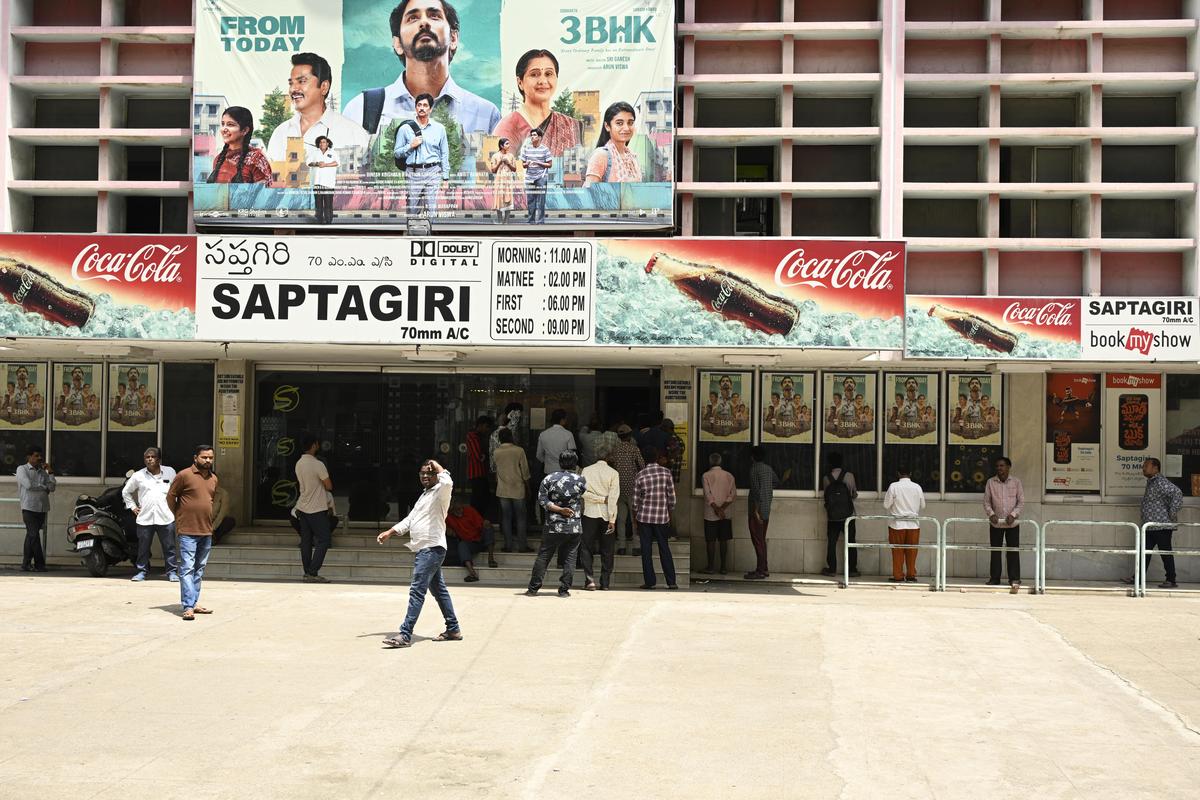
Very few films have managed to draw the audience in the last few years.
| Photo Credit:
File photo: Ramakrishna G
What the producers say
A few prominent producers also held a media interaction to explain their point of view. Producers Yalamanchili Ravi Shankar of Mythri Movie Makers, Suryadevara Naga Vamsi of Sithara Entertainments, Sahu Garapati, Sudhakar Cherukuri, Venkata Satish Kilaru and others participated in this interaction.
Ravi Shankar stated, “We agree that exhibitors are facing difficulties. But distributors and producers are also suffering. These issues cannot be solved overnight. Similar issues cropped up during the release of Hari Hara Veera Mallu.” Further, he questioned the timing of the issue prior to the release of a big budget film, which is likely to bring in the crowds.

The producers also pointed out that while a few single screens in Hyderabad and Telangana have been revamped with better projection facilities and amenities, several single screens have failed to do so, keeping the audience at bay.
Producer Naga Vamsi added, “The producers gathered here have at least 25 films in production, with 70–80% of the budgets already spent. Introducing a new system is not practical at this stage. We cannot accept such a policy for films already under production. For new films, we are open to discussing the percentage system — but only after discussions on theatre grading, maintenance charges and online ticket booking convenience fees.”
The tussle within the industry is also seen as a conflict between established players who have an entrenched production and distribution system and newer producers who are making inroads into the theatre networks.
Beyond the internal slug fest, what is of concern are the dismal footfalls in theatres across the Telugu States in the last few months, post Sankranti. The last Telugu film that generated some buzz and drew the audience to the theatres was the Adivi Sesh starrer Dacoit, which released on April 10.
A handful of new films have been released since then but went unnoticed. The IPL season has been cited as a possible reason that keeps the audience confined to their homes in the evenings. Samantha Ruth Prabhu’s Maa Inti Bangaaram, slated to arrive on May 15, has also been postponed to June 19.
The standoff between exhibitors and producers is likely to be resolved through talks before the release of Peddi. But it is imperative that the industry looks at issues of delayed productions and lacklustre narratives that fail to interest the audience. As a leading producer, who did not want to be named, says, “The fact that people are not showing interest in our films is more worrying.”
Published – May 15, 2026 05:46 pm IST
[ad_2]
Source link

 Total Users : 10220078
 Views Today : 309