

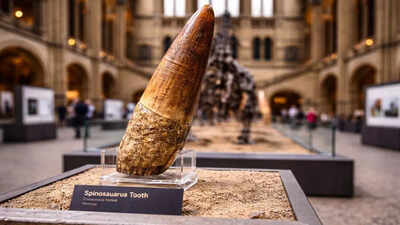
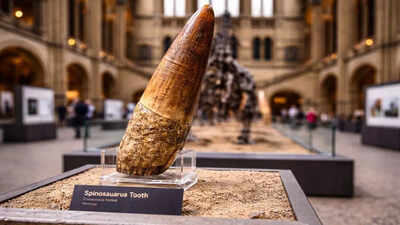
Having a piece of dinosaur history meant visiting museums or joining a fossil dig site. But today, fossil collecting is no longer just for scientists or museum visitors, as it has gone into the online marketplace. Dinosaur fossils, teeth, and other fossilised parts are now up for sale through various websites and social media sites, making these prehistoric treasures accessible to individuals worldwide.For journalist Jacopo Prisco, his adventure in fossil collecting started when he stumbled upon an offer for a Spinosaurus tooth fossil on an online marketplace for $100. The fossil was shipped in a glass display dome case along with a certificate of authenticity. At first glance, it seemed to be exactly that: a genuine fossil of one of the biggest predators that ever existed on Earth.But curiosity got the better of Prisco, leading him to dig deeper into the fossil’s origins, which would reveal a lot about the fossil business today.
How Spinosaurus teeth became popular in the online fossil trade
In the past few years, fossils have been made more accessible through online stores and social media. Fossils are not just found in museums or stores. Instead, you can now find dinosaur teeth, bones, and other fossils on online stores and social media pages. Sometimes, the algorithms on social media pages such as Instagram may promote a fossil ad to a person’s news feed if they have shown an interest in history, science, or collectables. Once a person clicks on a fossil ad, they may start seeing a lot of similar ads on their news feed, all selling fossils to collectors around the globe. Some of these include dinosaur teeth, especially Spinosaurus teeth, which are among the most common dinosaur teeth being sold online. This is because these teeth are quite unique and easy to identify, thus becoming a favourite among dinosaur tooth collectors.However, the rapid growth of the fossil trade on the internet has raised concerns among scientists. This is because they are not sure whether the buyer is aware of the fact that the fossils they are buying may not have been legally dug.
What makes a Spinosaurus tooth special
The dinosaur that is referred to as Spinosaurus was alive 95 million years ago during the Cretaceous period. Spinosaurus is considered to be one of the biggest meat-eating dinosaurs to have existed. The dinosaur is believed to have grown up to 50-60 feet in length.Unlike other meat-eating dinosaurs, Spinosaurus had a long nose like a crocodile. The dinosaur also had narrow teeth that were conical in shape. The dinosaur is believed to have spent most of its time near water and may have fed on fish as well.The teeth are unique and can be easily identified. This is the reason why the teeth are commonly collected by people. The teeth are ridged and have a long shape, making it easy for experts to identify them even when only one tooth is found.
Where most Spinosaurus fossils are found
Many fossils of Spinosaurus have been found in Morocco, especially in a fossil area referred to as the Kem Kem beds. This area is referred to as a geological formation that has deposits of fossils that existed millions of years ago, when this area was covered by rivers and wetland habitats.The area was home to numerous large reptiles and fish, which is why numerous fossils have been found in this area. Spinosaurus teeth are common fossils in this area because these animals constantly replaced their teeth during their lifetime. This means that when a tooth fell out, a replacement would grow in its place.Eventually, these teeth that fell out would be fossilised, which is why they are commonly found today.
Experts confirm the fossil but reveal a surprise
To be sure that his purchase was authentic, Prisco took the tooth to London’s Natural History Museum, where it was examined by a palaeontologist named Susannah Maidment, who confirmed that it was a fossil, most probably a Spinosaurus tooth.In addition, as a result of the assessment, it was discovered that although the fossil was authentic, it was not particularly rare, as Spinosaurus frequently loses its teeth, which then fossilise in many places in Morocco and other places where fossils are found.
The growing market for dinosaur fossils
The interest in fossils has grown many times over in recent years. Large auctions for complete specimens have captured the interest of the public worldwide. This has also encouraged many collectors to enter the market.For example, a Stegosaurus skeleton named “Apex” was sold for $44.6 million in 2024. This is the most costly fossil auction to date. Previously, in 2020, a well-known Tyrannosaurus rex fossil named “Stan” was auctioned for $31.8 million.Fossils have now become luxury items for collectors.Smaller fossils like teeth, bones, etc., are also available for sale on the internet at much lower prices.
Legal and ethical concerns in the fossil trade
The increasing fossil trade has also sparked concerns over its legality and ethics. The laws relating to fossils vary considerably between nations, and not all fossils are legally exported.Fossils can be collected and sold in Morocco if proper permits are obtained. However, if these documents are not obtained, it may be illegal to export them.Some other countries have even tighter laws regarding fossil exports. Brazil, Argentina, Mongolia, and China classify fossils as part of their heritage and do not allow them to be exported.Since detailed documentation is not provided on online selling sites, it is not clear whether the fossils are legally obtained or not.
The difficult work behind fossil discoveries
However, behind every available fossil for sale lie the workers who search for these fossils. In some parts of Morocco, many workers who search for these fossils can be found in remote desert areas. The workers dig rocks to find these fossils.The job can sometimes be very challenging and hazardous. The workers who mine these rocks can be found in tunnels that are dug in hills. The tunnels can sometimes collapse, and temperatures can also be a threat to these workers.The sale of these fossils is a very important source of income for many people in the region.What began as a simple purchase of a dinosaur tooth ultimately revealed the complicated world behind fossil collecting. A fossil may represent millions of years of natural history, but it can also carry stories about science, commerce, and the people who uncover these ancient remains.


 Total Users : 10073460
 Views Today : 631