

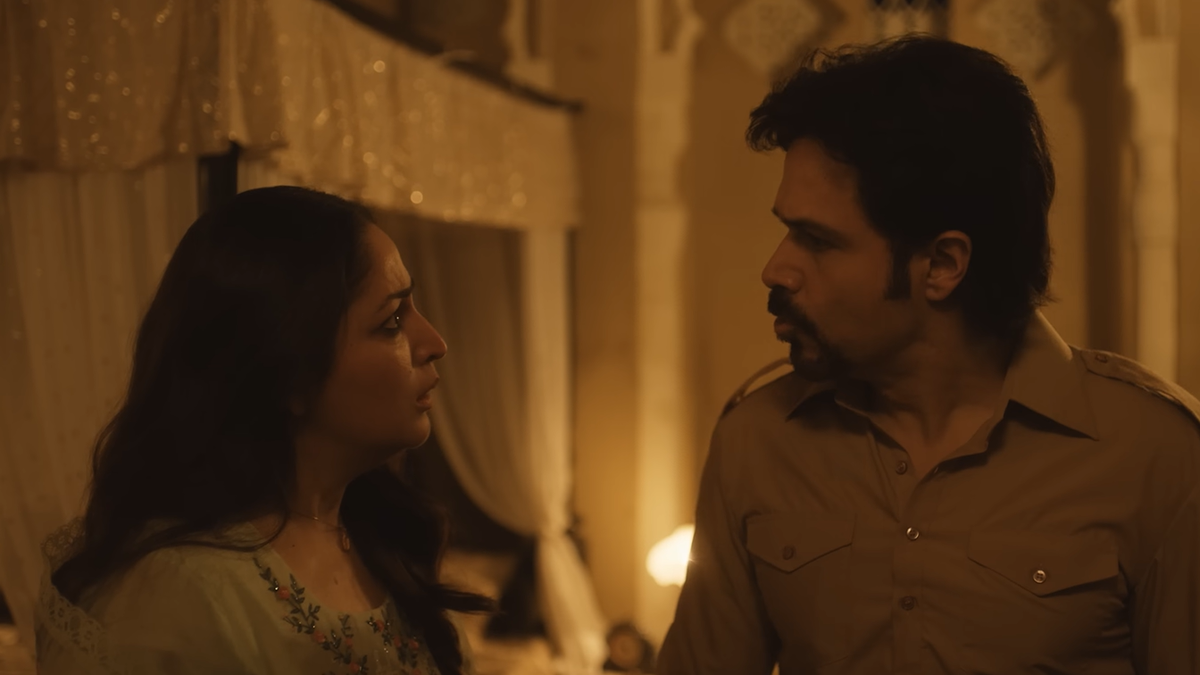
Contemporary Hindi cinema has made the crisis of conjugal relationships dramatically visible with props and plots on legality. Conjugality is contested from the perspectives of infidelity, violence, and abuse within marital relationships. The latest example is the elegantly curated Suparn Varma film Haq (2025). The film is premised on the famous Shah Bano case, which began in 1978 and continued till 1985. The consequent debates on Muslim women’s rights and the anomalies of instant triple talaq remain relevant even today.
Haq sensitively renews interest in the social and legal entanglements within which the female protagonist’s persistent pursuit of justice unfolds. Nearly five decades ago, B.R. Chopra’s musically entertaining, high-decibel melodrama Nikah (1982) had also dealt with the problem of triple talaq. In both Haq and Nikah, there is a significant resonance of the female protagonists’ clamour for a healthy conjugal relationship free from betrayal and abuse and conducive to gender equality.
Not just a film about Muslim women and social-legal complexities, Haq joins a range of popular Hindi films that aim to make a statement on conjugality and the crisis that besets it. An instant reminder is Gulzar’s politically charged drama Aandhi (1975), which portrays an estranged wife and husband, essayed by Sanjeev Kumar and Suchitra Sen, persistently longing for an ordinary conjugal life. The Aandhi song “tere bina zindagi se shikwa” summarises the whole tale. No less significant was J. Om Prakash’s musical hit Aap Ki Kasam (1974), starring Rajesh Khanna and Mumtaz, and Gulzar’s poetic masterpiece, Ijazat (1987). Both delivered a melancholic recapitulation of the breakdown of conjugality on the grounds of infidelity. Songs like “zindagi ke safar mein” in the sardonic voice of Kishore Kumar, or “mera kuch saman” in the deep husky lilt of Asha Bhosle, continue to haunt us melodiously even today.
In a historically long trajectory, Hindi cinema has shown the vulnerability of conjugal romance. Four decades ago, when popular Hindi cinema was dominated by remakes of films from South India, there were series of social dramas on the strengths and weaknesses of married life. T. Ramarao delivered a straightforward tale of infidelity and the consequent rupture in conjugality in Ek Hi Bool (1981).
Cinematic prototype of conjugality
A prototype of conjugality emerged in Hindi cinema from its early years. In the first quarter of the 20th century, Dadasaheb Phalke’s classic Raja Harishchandra (1913) retold the well-known story from the Puranas. A perfect eulogy for the conjugal relationship, the story received umpteen cinematic versions in regional languages. The key theme of each version is the tryst between a king committed to truth and Taramati, the king’s devout wife.
In Kannada cinema, there have been four versions of the same story since A.V. Meiyappan’s 1943 production, which was also dubbed into Tamil. Moreover, there were cinematic recastings of the Harishchandra Taramati tale in Marathi, Gujarati, Punjabi, Bangla, and other regional languages. Suffice it to say that these innumerable cinematic returns to the tale set a pan-Indian template of conjugality with an archetypal halo.
Departing from this prototype, the fissures and fractures in conjugality resulting from marital disputes between wife and husband became more central in cinema in the second half of the 20th century. A lesser-known film, Biraj Bahu (1954) by the maestro Bimal Roy, was based on the famous novel by modern classical litterateur Sarat Chandra Chattopadhyay. The film underlined the patriarchal moral judgment on the infidelity of a wife that upsets conjugal relations.
A Guru Dutt classic dealing with conjugality was Mr. & Mrs.‘55. In spite of its solid argument based on the then-passed divorce Bill in India, the film ingenuously persuades us to believe in the love, care, and empathy associated with post-marital conjugality. Most importantly, it serves as an early reminder of the negative consequences of societal interference between a wife and a husband.
On the other hand, Hrishikesh Mukherji’s musical masterpiece Abhimaan (1973) sharply critiques the toxic masculinity of a husband against an exceedingly successful wife. The estranged couple suffers the consequences and eventually surrenders to the intimate power of conjugality, which helps mend their broken relationship.
Another Guru Dutt magnum opus, Kaagaz Ke Phool (1959), underlined the fraying of conjugality, resulting in the husband’s quest for love and fulfilment elsewhere. To top it all, there is Basu Bhattacharya’s trilogy on married life, namely Anubhav (1971), Avishkar (1974), and Griha Pravesh (1979). Each film in the trilogy provides a sensitive portrayal of the complexities caused by both physical and symbolic infidelity, where both partners suffer with a deep longing to talk to each other and find a resolution.
The sombre melancholia in the cinematic texture of the trilogy continued in Bhattacharya’s last film, Aastha (1997). In between a tussle between infidelity and conjugality, the film shows a housewife driven by aspirations in a consumerist society, committing infidelity. She eventually finds resolution through an enabling conjugal relationship with her husband. However, Mahesh Manjarekar’s Astitva (2000) presents a counter-argument, depicting the violent abandonment of an unfaithful wife and the unequivocal collapse of conjugality.
The trend continued in the 2000s, which witnessed a significant rise in the dexterous treatment of the complexities of conjugality in popular Hindi cinema. In 2007, Anurag Basu’s masterpiece Life in a… Metro and Reema Kagti’s Honeymoon Travels Pvt. Limited offered a sensitive depiction of the hum and lull of conjugal romance.
Good old days and today
Such an abundance of cinematic engagement with conjugal relationships must be discerned in the wake of a weakening sense of conjugality in contemporary society. There are disturbing statistics of exceedingly rising cases of saddening separation, mushrooming misunderstanding, anguish and estrangement of the partners, also traditionally called wife and husband. Sadly, this shows a weakening of the family and adverse consequences on the mental health of the married couple and children.
In spite of our heightened critical awareness of the intricacies and anomalies of the institutions, we can seldom deny the significance that conjugality holds for us. In a volatile world seduced by desire, Hindi cinema, in its own ways, reminds us to navigate manifold genuine challenges and ensure that the beauty of conjugality does not metamorphose into a monstrous banality.
(Dev Nath Pathak teaches at South Asian University, New Delhi and is the author of the book, In Defense of the Ordinary)
Published – March 06, 2026 08:30 am IST


 Total Users : 10069456
 Views Today : 867