

[ad_1]
Chinese proverb of the day (AI-generated image)
Some proverbs sound warm immediately. Some feel comforting. Others arrive with a strange kind of bluntness and make people stop for a moment.This Chinese proverb belongs in the second category.“Better to be a dog in times of tranquility than a human in times of chaos.”At first reading, the words can sound surprisingly harsh. Why would anyone compare human life with that of a dog and suggest the dog has the better deal? It almost feels backwards. Humans usually imagine themselves at the top of things, with intelligence, freedom and control over their surroundings.Then the meaning starts settling in.The proverb is not really about dogs at all. It is about peace, stability and the value of living in a world where ordinary life can continue without fear.And suddenly the sentence feels much bigger.
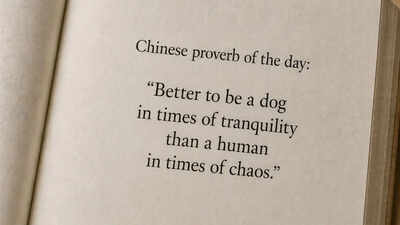
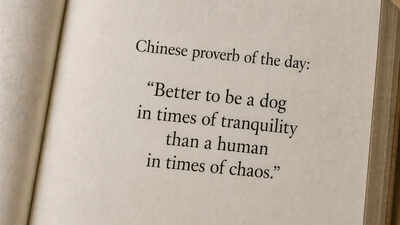
Chinese proverb of the day
“Better to be a dog in times of tranquility than a human in times of chaos.”
What does this Chinese proverb actually mean
The central idea behind the proverb seems fairly simple: peaceful times matter more than status, power or even human privilege itself.A dog living in calm surroundings has food, safety and predictable routines. Life may be simple, but there is security in that simplicity. During chaotic periods, human life can become filled with uncertainty, fear and struggle. Wars, political instability, social unrest or economic crises can affect nearly every part of daily existence.The proverb appears to suggest that stability itself is a form of wealth.That is interesting because people often focus on visible forms of success. Bigger houses. Better careers. Higher status. More possessions.Yet during periods of chaos, many of those things can suddenly feel far less important.People often begin wanting something much simpler.Peace.
Why these words still feel relevant today
Even though the proverb comes from an older tradition, it does not feel distant from modern life.People today live in a world that often feels fast and uncertain. News cycles move constantly. Political tensions appear regularly across different countries. Economic pressures affect families. Online spaces create endless noise and arguments.Many people probably understand the feeling of mental exhaustion that comes from constant instability.You can sometimes see it in everyday conversations. People talk about wanting slower lives. Less stress. Fewer distractions. More balance.Interestingly, those wishes often sound smaller than traditional ideas of success.Nobody says, “I just want more chaos in my life.”People usually say they want peace.The proverb seems to understand that instinct deeply.
Why calm periods often go unnoticed
One strange thing about peaceful times is that people do not always appreciate them while living through them.Human beings tend to adapt quickly. A stable routine starts feeling ordinary after a while. Safe neighbourhoods become expected. Quiet evenings feel normal. Predictable daily life stops feeling special because people become used to it.Then something disrupts that stability.Suddenly, the ordinary things seem much more valuable.People start missing small routines they barely noticed before. Family meals. Walking outside without worry. Going to work normally. Meeting friends casually.The proverb quietly points toward that idea.Sometimes people understand the value of peace most clearly after it disappears.
The quote says something interesting about human ambition
There may be another layer hidden inside these words, too.Modern culture often encourages constant ambition. Bigger goals. More achievements. More competition. Keep moving forward. Keep reaching higher.There is nothing wrong with ambition itself.Still, endless pursuit can occasionally make people overlook something important: a peaceful life has value too.Many individuals spend years chasing bigger things only to realise later that they were actually searching for stability all along.A calm home.Good health.Meaningful relationships.Time with people they care about.Those things can seem ordinary until life becomes chaotic.Then they suddenly become everything.
Why dogs appear in the proverb
The image of the dog feels interesting because dogs often symbolise loyalty, simplicity and basic contentment in many cultures.A dog is not worried about status or social position. It does not spend time comparing itself with others. Its concerns are much more immediate: food, safety, companionship and shelter.The proverb uses that comparison to create contrast.Human beings possess enormous advantages intellectually and socially, yet during chaotic periods, they also carry heavy emotional burdens. Fear, uncertainty and anxiety become constant companions.The dog in peaceful times may have less power, but perhaps it experiences more security.That seems to be the point.
Why people still return to old proverbs
Ancient proverbs survive because they often describe human experiences that keep repeating across generations.Technology changes constantly.Cities change.Politics changes.Human emotions stay surprisingly familiar.People centuries ago worried about uncertainty, safety, family and stability just as people do now. That continuity may be why older sayings still feel meaningful despite enormous differences between worlds.This proverb feels less like advice and more like observation.A reminder that peace itself carries value.
Other well-known Chinese proverbs
- “The best time to plant a tree was twenty years ago. The second best time is now.”
- “A journey of a thousand miles begins with a single step.”
- “Teachers open the door, but you must enter by yourself.”
- “Learning is a treasure that will follow its owner everywhere.”
- “He who asks a question remains a fool for five minutes; he who does not ask remains a fool forever.”
- “Tension is who you think you should be. Relaxation is who you are.”
Why this proverb still matters now
The quote does not say people should stop pursuing goals or avoid ambition completely. It simply reminds readers that stability and peace should never be treated as small things.People often imagine happiness arriving through dramatic achievements. Bigger moments. Bigger successes.Yet many discover that contentment sometimes lives inside ordinary things instead.A peaceful day.A safe home.A quiet routine.Time spent with people who matter.Perhaps that is why this proverb continues surviving across generations. It reminds people that during chaotic times, even simple peace can feel like an extraordinary gift.
[ad_2]
Source link

 Total Users : 10214751
 Views Today : 3765