

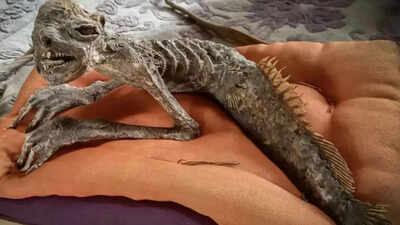
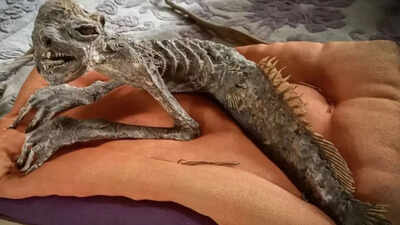
A “mummified half-fish, half-human” figure was reportedly found in an old house in Fukushima. The skeletal remains appear to have a humanoid upper body with long arms and claw-like hands. Its mouth contains multiple pointed teeth, and the lower body has a fish-like tail with scale-like textures. Experts say the model is likely crafted rather than a preserved biological specimen. Images of the figure have circulated online, drawing attention. The figure is linked to the kappa, a creature from Japanese folklore. Organisers of a local exhibition plan to display the figure, and it is reportedly available for purchase.
Mummified mermaid discovered in Fukushima with traits linked to kappa folklore
The figure reportedly combines human and aquatic features. The torso is humanoid. The hands are elongated, the mouth has rows of pointed teeth, and the lower body ends in a tail fin. Experts note the figure is about the size of a child, which is consistent with other similar models. It is thought to have been constructed using animal bones and other materials. There is no evidence that the figure represents an actual living creature, but rather folklore rather than a biological specimen.Kappa are water-dwelling creatures from Japanese mythology. They are believed to be living in water bodies like rivers and ponds. They are traditionally depicted as having scaly skin, webbed hands and feet, and a hollow on the top of the head filled with water. Stories about kappa tell of them being mischievous and, at times, harmful. They are believed to tend to steal food, challenge people to wrestling, or pull animals and humans into the water. The kappa can be seen in Edo-era art, literature, and the current day in the form of manga and anime. Experts believe that models like this were made to visually depict the kappa.
Fukushima finds rare mummified mermaid reflecting kappa folklore
Reports indicate that around ten similar “mermaid” or kappa figures exist in Japan. These models were reportedly made for religious purposes, education, or to attract visitors to cultural sites. Many of these figures were displayed at temples or shrines. Experts say that creating representations of mythical creatures was a common practice. These figures are considered important for studying historical approaches to folklore and local culture.As reported by The Sun, the figure is scheduled to be displayed at the Yonezawa City Citizens’ Gallery in Yonezawa. The exhibition is part of the Oshu Rare Treasures Market, taking place on March 28 and 29, 2026. After the exhibition, the figure is reportedly available for purchase. Organisers have estimated the value at around £11,755. Previous sales of similar figures have demonstrated collector interest in rare folkloric artefacts.
Composition and authenticity
Experts say the figure was likely assembled from animal bones and other materials. Similar mummified figures have been studied previously, and scientific analysis has confirmed their artificial composition. The reported mermaid model does not appear to represent a real organism. It is considered a crafted artefact, created to visually represent folklore rather than a living being.


 Total Users : 10078919
 Views Today : 1272