

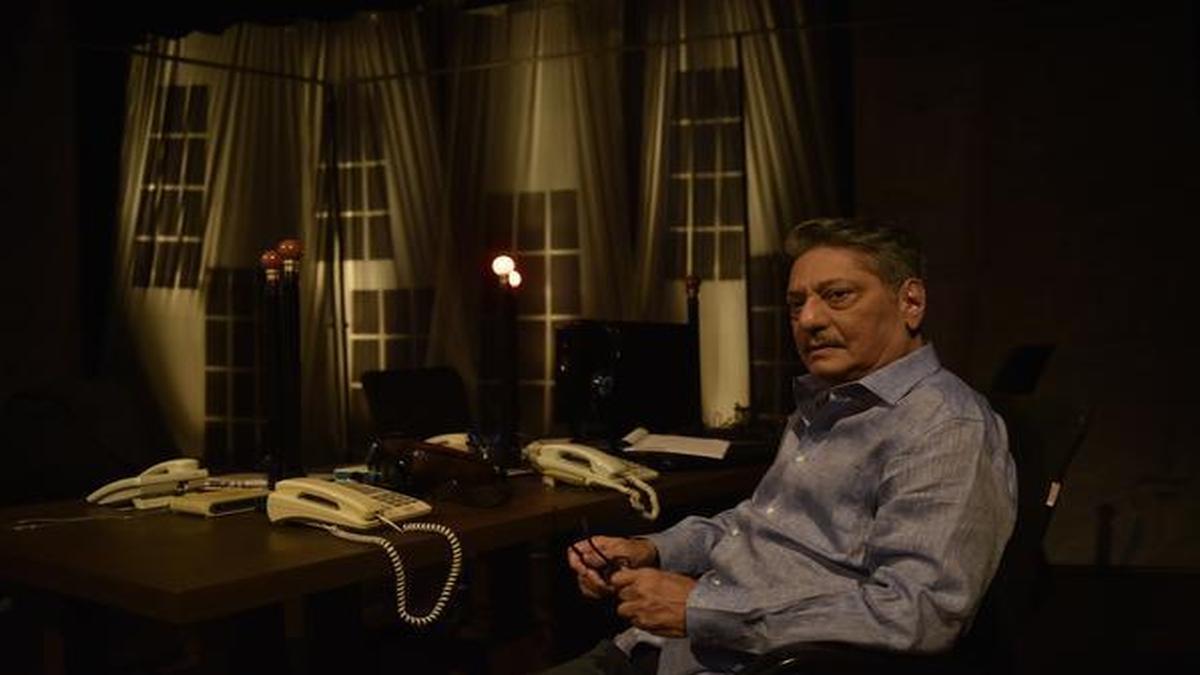
One of post-Independence India’s influential theatre figures, Amol Palekar’s experimental ethos and disciplined artistry have profoundly influenced Marathi and Hindi performance traditions.
Beginning as a fine arts postgraduate at the Sir J.J. School of Art, he engaged deeply with Marathi theatre under the mentorship of the formidable Satyadev Dubey, appearing in landmark productions such as Shantata! Court Chalu Aahe, Hayavadana, and Adhe Adhure.
In 1972, Palekar founded his own troupe, Aniket, to champion unconventional projects — directing and acting in plays such as Gochi, the procession-style Juloos and Chal Re Bhoplya Tunuk Tunuk, often staged in open spaces or non-traditional venues to disrupt passive spectatorship and bring theatre closer to everyday realities.
Preferring restraint, precision and fidelity to the written word instead of flashy improvisation, the strong advocate for free speech infused his stagecraft with a painter’s eye for composition and subtlety, qualities that later defined his naturalistic screen presence.
While Palekar’s contemporaries became prisoners of their image, he remained determined not to be typecast. In fact, he says, he wrote his memoir Viewfinder to reintroduce himself beyond the image of a boy next door or the Golmaal actor.
Preparing for one more comeback under the direction of his doughty partner Sandhya Gokhale, the veteran speaks about how his work has long embodied the abiding power of subtle revolution.
Edited excerpts from an interview:
How do you view the META Award for Lifetime Achievement in theatre? Is the recognition delayed? Has your film career in any way overshadowed your contribution to theatre?
Any award, to my mind, is a validation that what one has pursued over decades has had artistic and social relevance. I accept this award with a certain perspective. As Rabindranath Tagore wrote, “I slept and dreamt that life was joy; I awoke and saw that life was service; I acted and behold, service was joy.” In that sense, the work itself has always been its own reward. The honour, whenever it comes, is only incidental. Yes, in my case, the recognition is delayed. One has seen many mediocre practitioners receiving honours very early in their careers. I neither sought validation nor solicited recognition. Unfortunately, for a larger public, my identity has been largely defined by my film career and the popular image associated with it. That visibility has, in a way, overshadowed my work in visual arts and theatre, which was always very fulfilling.
It seems that, much like painting, your involvement in theatre happened unexpectedly. Could you describe how Satyadev Dubey discovered you?
I neither aspired to act nor to direct; it was never a conscious pursuit. My association with Satyadev Dubey began almost incidentally, when he chose me for my first acting assignment in Chup Court Chalu Hain. That decision entirely came from his instinct and his faith in me.. What that faith did was crucial. It gave me a sense of confidence I did not know I possessed. Under his guidance, I began to discover not just the craft of theatre, but also my own creative instincts. What started as an accident gradually evolved into a deeply fulfilling artistic journey, where I found myself growing, experimenting and flourishing both creatively and intellectually.
Amol Palekar in the play ‘Kusur’
| Photo Credit:
Special Arrangement
There is flair, and then there is technique. In your case, how do the two work as actor and director?
Flair, by itself, can be impulsive and fleeting; technique can become rigid and lifeless. As an actor and director, I have always tried to negotiate a space where instinct is informed by craft, and craft remains alive through instinct. It is in that dialogue between the two that meaningful theatre, for me, begins to emerge.
Tell us about the role of Dubey and Sombhu Mitra in shaping your career on stage.
Dubey prepared me holistically. With him, theatre was never fragmented into isolated departments. He made me understand the significance of every element on the proscenium — light, music, space design. More importantly, he taught me how to interpret a text and translate that interpretation into a coherent theatrical experience. With Sombhu da, my learning was of a different order. Watching him, one understood how an actor can draw the audience into the magic of illusion. Between the two, I came to understand the relationship between flair and technique. Technique gives the actor and director their foundation, the grammar and discipline of the craft. But it is flair that animates it, that allows the work to breathe and reach the audience.
As a theatre director, can you explain the challenges you faced working with playwrights like Badal Sircar, Girish Karnad, and Mahesh Elkunchwar?
The tension often arose from interpretation. A playwright writes with a certain vision, but a director, in the act of staging, inevitably interprets the text through a different lens. The question then becomes — where does the director’s freedom begin, and where does it cross the writer’s?
Both Badal Sircar and Sadanand Rege were generous in allowing me that freedom. With Girish Karnad, I never felt the need to alter anything, as his writing had a precision and completeness that required no intervention on my part. Mahesh Elkunchwar, on the other hand, was understandably very possessive about his text. When I reduced Vasanakand script by almost 30 minutes, he did not object. But he criticised me for the omissions I made while staging Party. So the issue is recognising creative boundaries, understanding how far a director can go without violating the integrity of the playwright’s vision. Over time, I have come to believe that any such intervention must be accompanied by dialogue.
How did painting influence your theatre choices, and how did theatre practice contribute to performing for the camera?
My approach has always been minimalist. In painting, I was deeply aware of the areas I chose to leave unpainted; the white spaces that remain untouched. Those spaces are not accidental; they are deliberate. The same sensibility informed my theatre — the use of silence, of pauses, of restraint. Painting also shaped my perspective of theatre as a visual medium. My understanding of composition, lighting, colour palette and texture began to influence how I visualised and staged my plays, and later, my films. Lighting, especially, became a crucial element, not just to illuminate, but to create mood and structure meaning.
At the same time, theatre contributed significantly to my work in front of the camera. It instilled a sense of rhythm, timing, and discipline. On stage, one learns projection; for the camera, one learns containment. Theatre taught me control, while painting expanded my visual imagination — the two constantly informing each other.
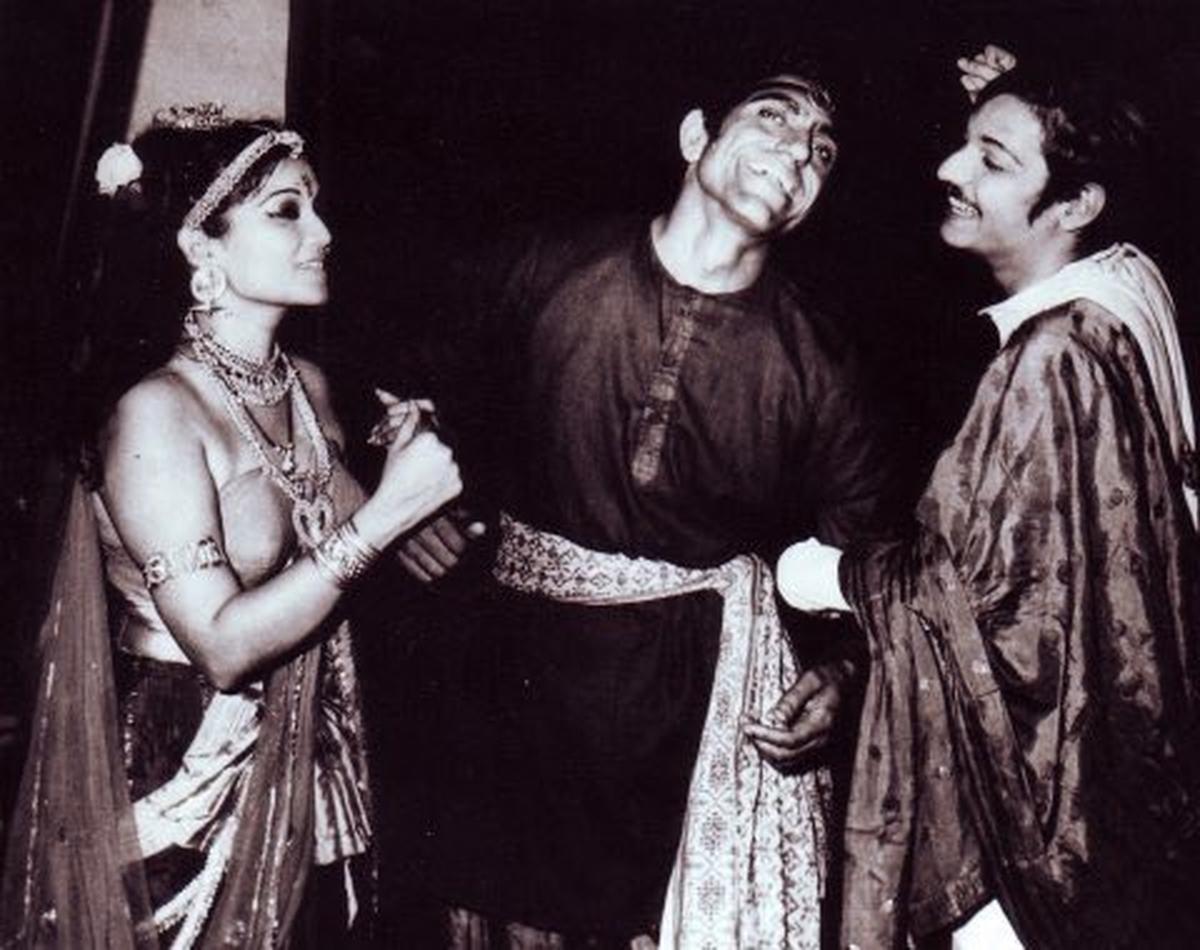
Amol Palekar with Amrish Puri and Sunila Pradhan during the rehearsal of Girish Karnad’s Hayavadana.
| Photo Credit:
Special Arrangement
Despite being an outsider and achieving success, you chose not to fully embrace mainstream theatre. How did you manage the balance between creative satisfaction and commercial success?
I have always had a certain aversion to what is broadly called commercial theatre. It was not a moral position so much as an aesthetic one. The subjects, the performances, even the set design, often did not appeal to me. I was always searching for a path less travelled, something that would challenge me creatively rather than reassure me with familiarity. My work in films, in a way, made that independence possible. But even within cinema, I was careful about my choices. After the early success of three silver jubilee films as a debut actor, I consciously moved towards roles that were unexpected, even negative, simply to avoid being trapped in an image.
For me, the real balance was never between art and commerce, but between integrity and convenience. One may earn a livelihood through one’s work, but if money becomes the sole measure of success or fulfilment, then the very purpose of engaging with art begins to diminish.
You’ve been a vocal advocate against pre-censorship. What changes have you seen in censorship practices over the decades, and where do we stand today?
The fundamental thrust behind censorship is to interfere with artistic expression. The mechanisms may evolve, the language may shift, but the impulse to control what is expressed persists. What has changed more noticeably is the nature of that control. Increasingly, the prevailing political ideology of the time begins to dictate what is permissible. We stand at a point where the need to safeguard artistic freedom is more urgent than ever. Beyond formal state mechanisms like censor boards, there are also sections of society that are mobilised to protest against dissent, where the claim of “hurt sentiments” becomes a convenient and frequently used pretext. Theatre, by its very nature, engages directly with society; it provokes, reflects, and questions. To impose pre-censorship on such a medium is to diminish its very purpose.
What, according to you, is the role of theatre? How do you see the present scene, particularly experimental and political plays?
During the Emergency, when I staged Julus, it was not merely a production; it was an act of protest against the prevailing authoritarianism. For me, theatre, like any art form, must have the courage to respond to its times. I have never subscribed to the idea of art for art’s sake. When the moment demands, the artist must raise a voice.
Today, however, one does sense a certain hesitation. Fear, in many ways, has muted artistic expression. Many practitioners tend to align with the dominant discourse, while those in the minority risk being sidelined. That is a troubling shift, because dissent and plurality are essential for any meaningful artistic culture. Self-censorship is the rule now!
At the same time, I see a great deal of energy and vitality, particularly in Marathi experimental theatre. Numerous new productions are truly enlivening the stage. What is encouraging is that younger practitioners are not only experimenting but are also finding audiences and patronage for such work.
You took a long break from theatre before returning with Kusur? Will we see one more comeback?
I do intend to return, later this year, with a fascinating English play written and directed by Sandhya Gokhale. Besides producing, I will also be acting in it. At my age, even a small challenge assumes significance. It demands a different kind of preparation, both physical and mental. But that is precisely what keeps the engagement alive… the need to test oneself, to step into something unfamiliar once again. Let us see how I can meet that challenge.


 Total Users : 10076853
 Views Today : 1421