


[ad_1]
We live in an era of constant connectivity, where the smartphone feels like an extension of our arm. In moments of overload, we romanticise the idea of a digital detox, of returning to a time when television and video cassettes were a luxury. Those were the days. Or were they?
There was a time when owning a television signalled status and power, and viewing, too, could become addictive. First-time director V. Muniraju’s Telugu film Thimmarajupalli TV revisits this moment, exploring television as an inflection point in a village in Andhra Pradesh, wrapped in a layer of nostalgia.

The film opens with a voiceover by actor-producer Kiran Abbavaram that breaks the fourth wall. He urges us to pay attention, even as he channels the voice of a television set. The TV recalls the pride of place it once held in homes, declaring, “those were the days.” Not the isolating experience it later became in urban households, but in the village of Thimmarajupalli, where watching television was a shared, communal ritual.
Thimmarajupalli TV (Telugu)
Director: V Muniraju
Cast: Sai Tej, Vedha Jalandhar, Pradeep Kotte, Swathi Karimireddy
Runtime: 124 minutes
Storyline: The arrival of a television set brings more than joy to a village. Life, as they knew it, undergoes a drastic shift.
The narrative travels back two decades, when villagers pooled in small sums to rent a television and video cassettes, staying up all night on Mahashivaratri to watch films.
Movie-watching is communal and joyous, even as fan rivalries simmer — should a Chiranjeevi film play first, or one starring Nandamuri Balakrishna? There is also an undercurrent in how men speak about the young women in the village.
Muniraju, who also writes and edits the film, keeps the setting grounded. The landscape and lifestyle are not overtly romanticised. When Akshay Ram Podishetti’s camera captures sweeping views of fields, rocks and distant hills, the beauty feels organic. As it moves closer, often with a handheld fluidity, it draws us into the lives of the villagers.

Authenticity extends to the casting. With nearly 50 newcomers, many from theatre, the performances feel lived-in. The homes (art director Sudheer Macharla), understated costumes (Vishalya) and dialect further root the film in its milieu.
The story itself is simple, almost like a short story, and I wondered if it can sustain a two-hour runtime. To its credit, the film remains engaging, aided by Vamsikanth Rekhana’s breezy, cheerful score in the early portions.
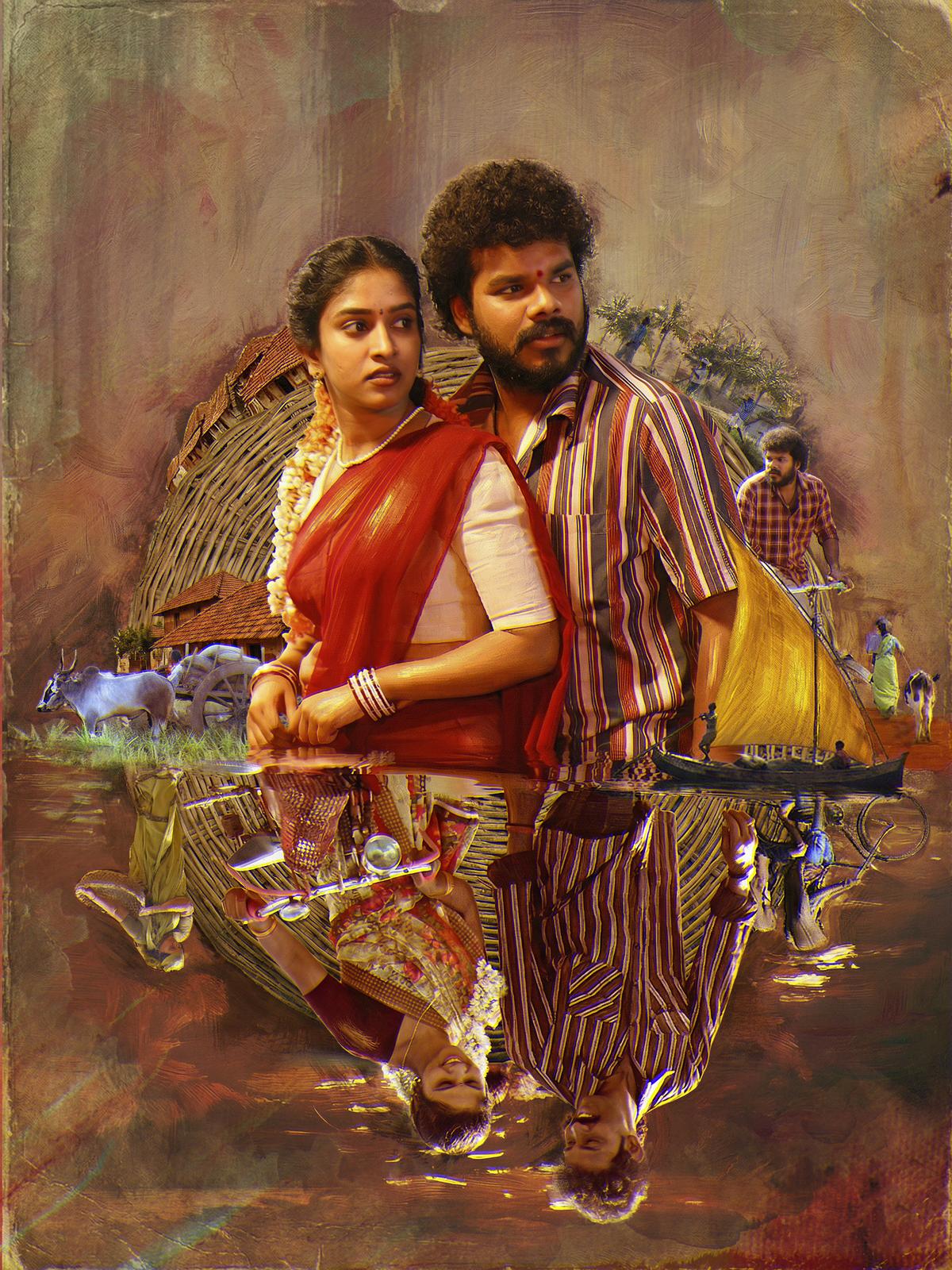
Sai Tej and Vedha Jalandhar in the film
| Photo Credit:
Special Arrangement
Conflict arrives when one villager buys a television with a satellite dish, which the villages refer to as “the giant umbrella.” For some, ownership signals power and sparks envy; for others, it becomes a gathering point, with visitors overstaying their welcome.
At this crossroads, television as addiction and as status symbol, stand a handful of characters, none painted in black and white. Satish (Sai Tej), the male lead, is a small-time thief who takes his mother’s labour for granted. Saradha (Vedha Jalandhar) is torn between love and family.
Around them, Muniraju introduces a range of characters — a protective brother and sister-in-law, a priest who fuels discord, a village elder wary of losing influence, and others waiting to stir trouble.
The pacing is brisk in the first hour before dipping briefly. As suspicion spreads in the latter half, the film regains intrigue, with performances keeping the narrative afloat.

The resolution, though somewhat straightforward, ties up multiple threads. Ultimately, the film becomes a coming-of-age story — not just for its protagonists, but for the community itself. The performances by Sai Tej, Vedha Jalandhar, Pradeep Kotte and Swathi Karimireddy stand out.
This is a simple, endearing film rooted in local subcultures. Momentarily it can also make viewers recall Mail: Kampalapally Kathalu, which explored the changes in a village when internet connectivity was a luxury.
Thimmaraupalli TV may not have the layered complexity of Care of Kancharapalem or Balagam, which dug deeper into human relationships and social dynamics, but it serves as a reminder that small stories can still surprise.
Published – April 17, 2026 02:53 pm IST
[ad_2]
Source link

 Total Users : 10224621
 Views Today : 4984